Food Card 2026: Everything You Need to Know About Eligibility, Benefits, and How to Apply
A Food Card can be an important source of support for individuals and families who need help managing their grocery expenses. With the cost of everyday essentials affecting household budgets, food assistance programs can help eligible people access food and manage their monthly spending more effectively.
However, applying for a Food Card can sometimes feel confusing. People may have questions about eligibility requirements, application documents, registration procedures, available benefits, and how to check their application status.
The good news is that understanding the process can make it easier to find the right assistance program for your circumstances.
In this guide, we explain everything you need to know about Food Card 2026, including who may qualify, what benefits may be available, how to apply, and what to do if your application is delayed or rejected.
Because Food Card programs differ by country, state, province, and organization, always check the official rules that apply to your location before submitting an application.
1. What Is a Food Card and How Does It Work?
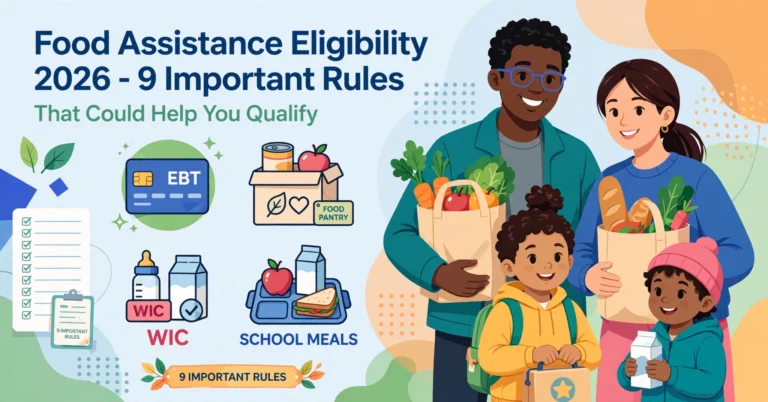
A Food Card is a general term for a card or benefit system designed to help eligible people obtain food assistance. Depending on the program, it may provide electronic benefits, grocery vouchers, discounts, or another form of approved support.
The main purpose of a food assistance program is to help eligible households access food when their available resources are limited.
For example, a family experiencing financial difficulties may struggle to cover groceries alongside rent, transportation, electricity, and other household expenses. If the family qualifies for a suitable Food Card program, the assistance may help reduce some of the pressure on its grocery budget.
How does a Food Card work?
The process depends on the program, but it generally follows several steps.
First, an individual or household checks the eligibility requirements. Next, the applicant submits the required information and supporting documents. The responsible organization then reviews the application and determines whether the applicant qualifies.
If approved, the recipient receives instructions explaining how to access and use the benefits.
Some programs use electronic cards that work at participating retailers. Others provide vouchers, discounts, or different forms of food assistance.
It is important to understand that not every Food Card works in the same way. Some programs restrict purchases to approved food products, while others follow different rules.
Before applying, check what the program provides, how benefits are delivered, and where they can be used.
2. Who Is Eligible for a Food Card in 2026?
Food Card eligibility is one of the most important topics to understand before starting an application.
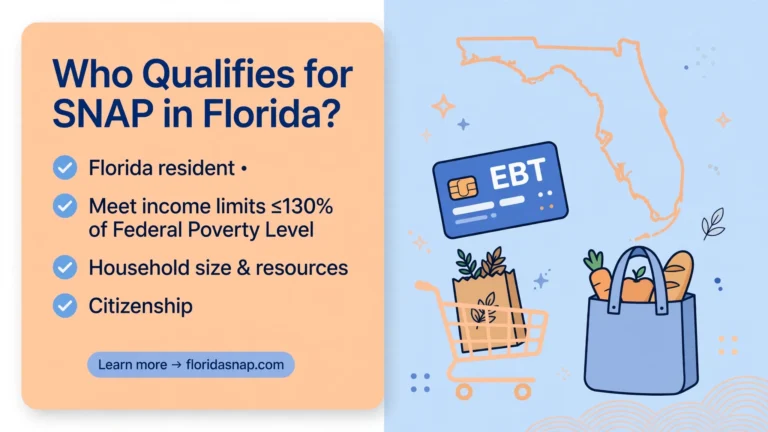
Although eligibility requirements vary, many food assistance programs consider an applicant’s income, household size, residency, and financial circumstances.
Meeting one requirement does not necessarily guarantee approval. The organization responsible for the program will assess the application according to its current rules.
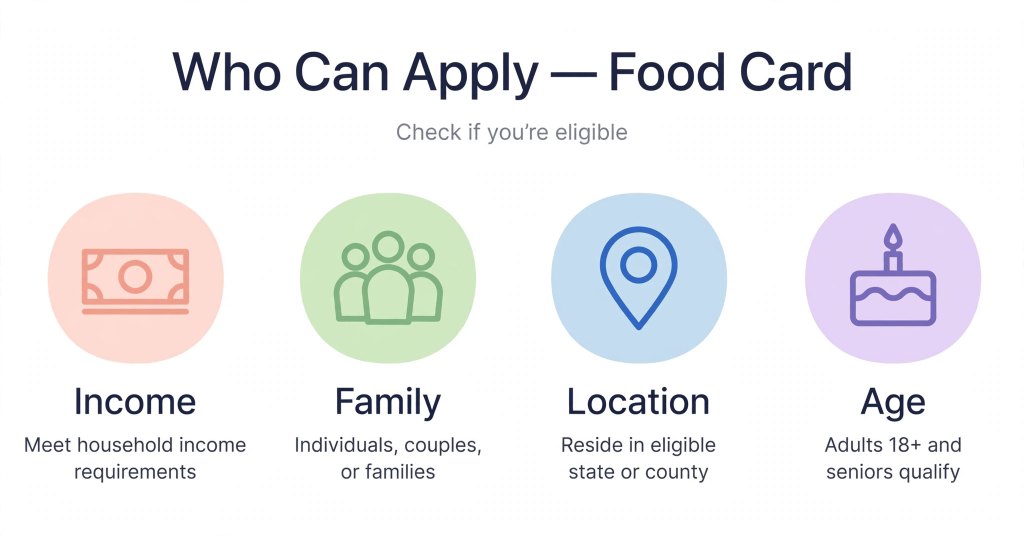
Income requirements
Some programs are designed for people and families whose income falls within specified limits.
The applicable limit may depend on household size, income type, and other program rules. Certain programs may also consider specific expenses or other financial circumstances.
If an income limit applies, check whether the program uses gross income, net income, or another calculation.
Do not rely on an income limit published for a different program or an earlier year.
Household size and family circumstances
Household size may affect eligibility or the amount of assistance available.
For example, a program may assess the circumstances of a household with children differently from those of an individual living alone.
However, each program defines a household according to its own rules. People who live at the same address may not always be treated as one household for eligibility purposes.
Residency requirements
Some programs are available only to people living in a specific country, state, province, or local area.
Applicants may need to provide proof of residence or other documents demonstrating that they meet the program’s requirements.
Additional rules may apply depending on the program and the applicant’s circumstances.
Other eligibility factors
Depending on the program, eligibility may also consider:
- Age or family circumstances.
- Disability-related circumstances.
- Employment or income information.
- Existing participation in another assistance program.
- Other requirements established by the responsible organization.
How can you confirm your eligibility?
The safest approach is to visit the official website of the organization providing the Food Card.
Read the eligibility information carefully and compare the requirements with your own circumstances. If anything is unclear, contact the official support service or an authorized assistance office.
Checking the requirements before applying can help you avoid unnecessary delays and prepare the correct documents.
3. What Are the Main Benefits of a Food Card?
The benefits of a Food Card depend on the program, but food assistance can provide useful support for eligible households.
Understanding the possible benefits can help you determine whether a particular program meets your needs.
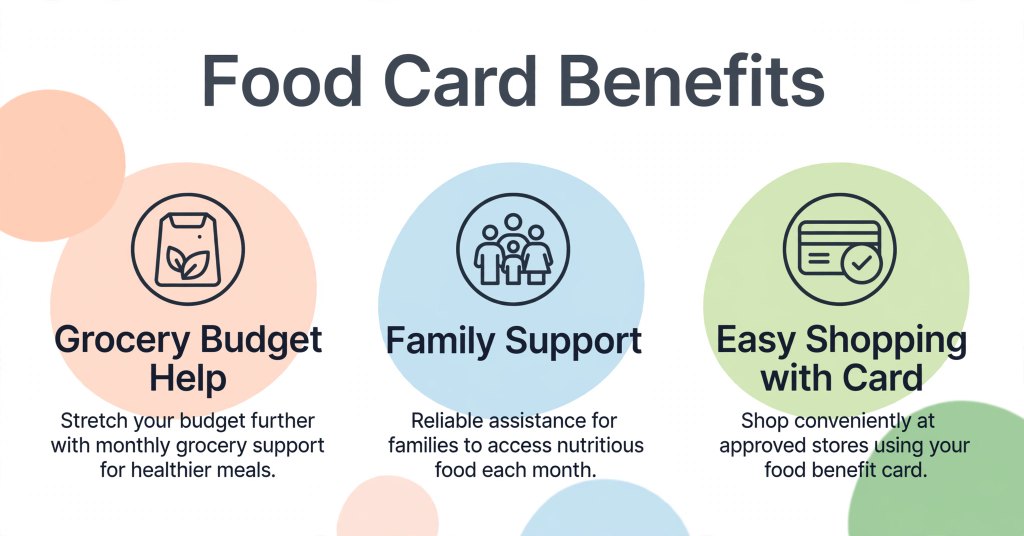
Help with grocery expenses
One potential benefit is assistance with eligible food purchases.
When a household receives food assistance, it may have more flexibility in its grocery budget. This can be especially helpful when money is needed for other essential expenses.
The actual financial benefit depends on the program’s rules and the recipient’s approved assistance.
Support for eligible families
Some programs are designed to assist households experiencing financial difficulties.
Depending on the eligibility criteria, support may be available to qualifying individuals, families with children, or other groups.
However, not every program serves the same population, so applicants should review the specific eligibility rules.
Convenient access to assistance
Where electronic cards are available, recipients may be able to access approved benefits through a participating retailer.
This can make the process more convenient than collecting certain types of assistance in person.
Other programs may use vouchers, discounts, or alternative arrangements.
Better household budgeting
A Food Card may help eligible households plan their food spending more effectively.
For example, if a household receives approved food assistance, it may be able to use its remaining available money for other essential needs.
This does not mean the assistance will cover every grocery expense. Instead, it may provide additional support within the program’s limits.
Important benefit rules to remember
Before using a Food Card, understand the following:
- Which food items are eligible.
- Which stores or providers participate.
- When benefits become available.
- Whether unused benefits expire.
- How to report a lost card or incorrect transaction.
Never assume that a particular benefit amount or purchase rule applies to every Food Card program.
4. What Documents Are Required to Apply for a Food Card?
Preparing your documents in advance can make the Food Card application process easier.
The exact requirements vary, but applicants may be asked to provide documents that confirm their identity, residence, income, and household circumstances.
Here are some common examples.
Proof of identity
An official identification document may be required to confirm who you are.
The accepted documents depend on the program and may include government-issued identification or another approved form of identification.
Proof of residence
Some programs require applicants to demonstrate that they live within the eligible service area.
Accepted evidence may vary, so consult the official checklist before submitting documents.
Income information
If eligibility depends on income, applicants may need to provide information about earnings or other financial resources.
Depending on the program, this could involve employment records, income statements, or other supporting documents.
Household information
You may need to provide information about household members, dependents, or other circumstances relevant to eligibility.
Make sure that the details you enter match the program’s instructions.
Additional documents
Certain applications may require extra information depending on the applicant’s situation.
For example, the program may request clarification about income, residence, or household circumstances.
Practical tip: Prepare a checklist before starting your Food Card registration. Make sure every required document is readable, current where necessary, and submitted through an approved channel.
Do not send sensitive documents to unofficial websites or unknown individuals promising guaranteed approval.
5. How to Apply for a Food Card in 2026
Applying for a Food Card generally involves identifying the correct program, checking eligibility, completing the required forms, and waiting for a decision.
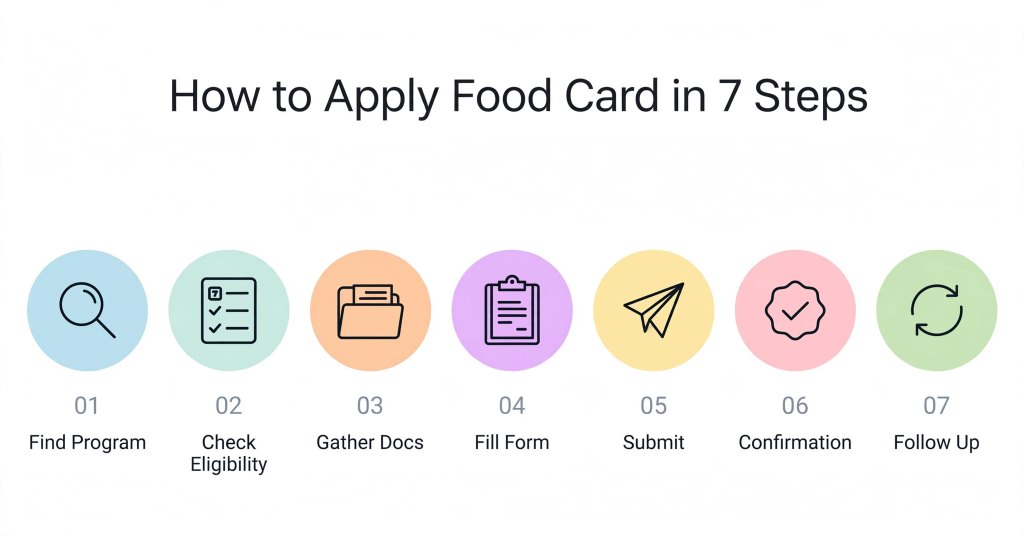
The following steps explain the typical process.
Step 1: Find the correct Food Card program
Start by identifying the government agency, charity, or organization responsible for providing food assistance in your area.
Search for the official program website or contact a recognized assistance office.
This step is important because similar names may be used for different programs in different locations.
Step 2: Check the eligibility requirements
Read the program’s current eligibility rules before completing the application.
Check the income requirements, residency conditions, household rules, and any other criteria that apply.
If you do not understand a requirement, ask the program’s official support team for clarification.
Step 3: Gather your documents
Prepare all the documents listed in the official application instructions.
Check that the information is accurate and that any uploaded files are clear and complete.
Having the required information ready can reduce the chance of an incomplete application.
Step 4: Complete the application form
Enter the information requested by the program.
This may include your name, contact information, residence, household details, and income information.
Read each question carefully. Incorrect or inconsistent information may lead to additional verification or delays.
Never provide false information to qualify for benefits.
Step 5: Submit your application
Use one of the submission methods officially accepted by the program.
Depending on the service, you may be able to apply online, submit a paper form, or visit an authorized office.
Follow the instructions provided and keep a copy of your submission if possible.
Step 6: Save your confirmation details
After submitting the application, save the confirmation message, receipt, or reference number.
These details may be needed to check your Food Card application status or contact the program about a delay.
Step 7: Follow up when necessary
Some programs may contact applicants to request additional documents or verify information.
Check your messages and respond within the stated deadline.
If you do not receive an update within the published processing period, contact the official support service to ask about the status of your application.
Remember that applying for a Food Card does not guarantee approval. The responsible organization must first determine whether you meet the program’s requirements.
6. How to Complete Food Card Registration Online
Online registration can be convenient when a food assistance program offers an official digital application service.
However, online registration is not available for every program. Check the official instructions before beginning.
Visit the official website
Start by locating the verified website of the organization responsible for your Food Card program.
Check the website address carefully. Avoid sponsored or unofficial pages that imitate government services or ask for unnecessary personal information.
Create an account if required
Some programs require applicants to create an online account.
If this applies, follow the instructions and use secure account credentials. Keep your login information private.
Enter your information
Complete the online form using accurate personal, household, and financial information.
Review every section before moving forward.
Upload supporting documents
If document uploads are required, follow the accepted file formats and size limits shown on the official website.
Make sure the documents are clear and contain the information needed for verification.
Review and submit
Before submitting the form, check your entries for mistakes or missing information.
After submission, save the confirmation details and follow the program’s instructions for checking your application.
Avoid online registration scams
Be careful with websites or messages that promise immediate Food Card approval for a fee.
Do not share passwords, PINs, or banking information with unverified contacts. If you are uncertain about a website, contact the official program directly.
7. How to Check Your Food Card Application Status
After submitting an application, many people want to know whether it has been received, approved, or delayed.
The available methods for checking your Food Card application status depend on the program.
Use the official online portal
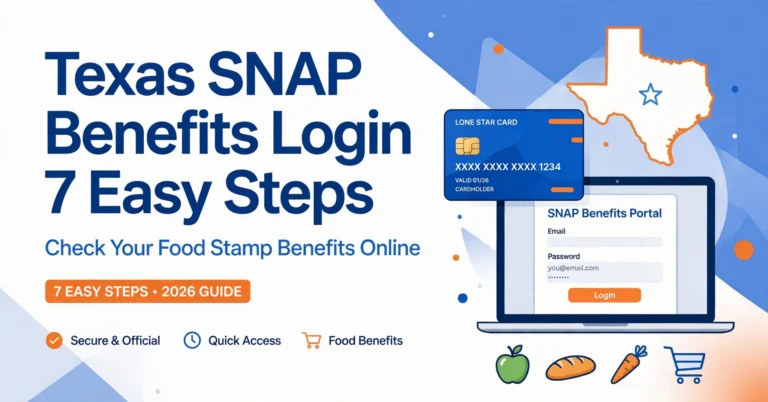
If online tracking is available, sign in to your account and look for an application status section.
You may need your application reference number or other verification information.
Contact the official support service
Some programs provide a telephone helpline or authorized local office where applicants can request an update.
Keep your application reference number ready and follow any identity verification instructions.
Understand common application statuses
Your application may display a status similar to one of the following:
- Received: The program has received your application.
- Under review: Your information is being assessed.
- Additional information required: The program needs more documents or clarification.
- Approved: Your application has been accepted under the program’s rules.
- Denied: Your application was not approved.
These labels are examples. The exact wording and meaning depend on the system being used.
What if your application is delayed?
First, check whether the program has published an expected processing time.
Next, confirm that you submitted all required information and check for messages requesting additional documents.
If the expected period has passed, contact the official service and ask whether anything is needed from you.
Avoid submitting duplicate applications unless the program instructs you to do so.
8. How to Check Your Food Card Balance and Benefits
If you already receive Food Card assistance, checking your available balance can help you plan grocery purchases.
The correct method depends on the program that issued your card.
Check through an official website or app
Some programs provide an online account or mobile app where recipients can view their available benefits and transaction history.
Use only the official service associated with your program.
Use an approved telephone service
Certain programs provide an automated telephone system or customer support number for balance inquiries.
Check the official program instructions for the correct number.
Review transaction receipts
Where available, receipts from participating retailers may help you understand how much assistance remains after a purchase.
Keep receipts when possible, especially if you need to report a transaction that appears incorrect.
Understand your benefit schedule
Some programs issue benefits according to a schedule, while others use different arrangements.
Check the rules for when benefits become available and whether any expiration or rollover conditions apply.
If your expected benefits are missing, contact the program’s official support service rather than relying on unverified information online.
9. Common Food Card Application Mistakes to Avoid
A few simple mistakes can make the application process more difficult. Understanding them in advance can help you submit a more complete application.
Providing incorrect information
Incorrect income, household, or residence information may lead to verification problems.
Review the form carefully and correct any errors before submission.
Forgetting required documents
An application may be delayed if supporting documents are missing.
Use the official checklist to confirm that you have included everything required.
Uploading unclear documents
Blurry images or incomplete files may make verification difficult.
Check the quality of each document before uploading it.
Using an unofficial website
Fake registration pages can put your personal information at risk.
Always confirm that the website belongs to the responsible organization or an authorized service provider.
Ignoring official messages
If the program requests additional information, respond within the stated deadline.
Missing a deadline may affect your application, depending on the applicable rules.
Assuming approval is automatic
Submitting a Food Card application does not mean you have been approved.
Wait for an official decision and follow the instructions provided by the program.
10. What Should You Do If Your Food Card Application Is Rejected?
Receiving a denial can be frustrating, especially when you were counting on assistance.
However, it is important to understand the reason for the decision before deciding what to do next.
Read the decision notice
The notice may explain why your application was rejected and whether further action is possible.
Read it carefully and keep a copy for your records.
Check for missing or incorrect information
Some applications may be denied because information was incomplete, documents were missing, or details could not be verified.
If the problem involves an error, ask whether you can correct it or submit additional evidence.
Ask about an appeal
Depending on the program, applicants may have the right to request reconsideration or appeal a decision.
Check the official instructions and pay attention to any deadlines.
Apply again only when appropriate
A new application may be suitable in some circumstances, but it is not always the correct next step.
Follow the instructions provided by the program or seek guidance from an authorized assistance organization.
The most important thing is to understand the reason for denial and identify the options actually available under the relevant rules.
11. How to Use Your Food Card Safely and Responsibly
Protecting your Food Card is important because it may provide access to essential assistance.
Whether your benefits are delivered through an electronic card, an online account, or another system, take reasonable steps to protect your information.
Keep your account details private
Do not share your password, PIN, or verification codes with strangers.
Use secure passwords and follow the program’s recommendations for protecting your account.
Report a lost or stolen card
If your card goes missing, contact the official support service as soon as possible.
Ask how to block the card, protect any remaining benefits, and request a replacement if permitted.
Watch out for scams
Be cautious of messages promising guaranteed approval or demanding payment to release benefits.
Verify suspicious communications through the program’s official contact channels.
Follow the purchase rules
Use your Food Card according to the program’s requirements.
Some programs restrict purchases to approved food items or participating retailers. Others may have different conditions.
Read the official rules so you understand what is permitted.
Review transactions regularly
Check your balance and transaction history where these services are available.
Report suspicious or incorrect transactions through the official process.
12. Frequently Asked Questions About Food Card 2026
What is a Food Card?
A Food Card is a general term for a card or benefit system used by a particular program to provide food-related assistance. The type of support and the rules depend on the organization providing it.
Who can apply for a Food Card in 2026?
Eligibility depends on the program. Common factors include income, household size, residency, and other circumstances specified by the responsible organization.
Can I apply for a Food Card online?
Some programs offer online registration, while others require an in-person application or another approved method. Check the official website for your area.
What documents do I need for a Food Card application?
You may need proof of identity, residence, income, and household circumstances. The exact checklist depends on the program.
How long does Food Card approval take?
Processing times vary by program and application. Check the official processing guidance or contact the responsible office for current information.
How can I check my Food Card application status?
You may be able to check through an official online portal, an approved telephone service, or a local assistance office.
How can I check my Food Card balance?
Depending on the program, you may be able to check through an official app, online account, telephone service, or transaction receipt.
What should I do if my Food Card application is rejected?
Read the denial notice, identify the reason, and check whether the program permits corrections, reconsideration, or an appeal.
Can I use my Food Card at any grocery store?
Not necessarily. Some programs restrict use to participating retailers or eligible purchases. Review the rules associated with your card.
Is Food Card registration free?
Registration fees depend on the specific program and its official procedures. Verify any claimed fee with the responsible organization before paying. Be cautious of unofficial services that promise guaranteed approval.
Conclusion: Get Started With Your Food Card Application in 2026
A Food Card may provide useful support to eligible individuals and families who need help managing food expenses. However, understanding the program’s requirements is essential before applying.
Start by identifying the correct food assistance program in your area. Review its eligibility rules, prepare the required documents, and complete the application carefully. If online registration is available, use the official website and save your confirmation details.
After applying, check your Food Card application status through an approved channel and respond promptly to requests for additional information. If your application is rejected, review the decision notice and determine whether correction or appeal options are available.
Most importantly, remember that Food Card eligibility, benefits, and application procedures vary by program and location. Always rely on current official information rather than assuming that the same rules apply everywhere.
With the right information and careful preparation, you can better understand your options and take the appropriate next step toward food assistance in 2026.