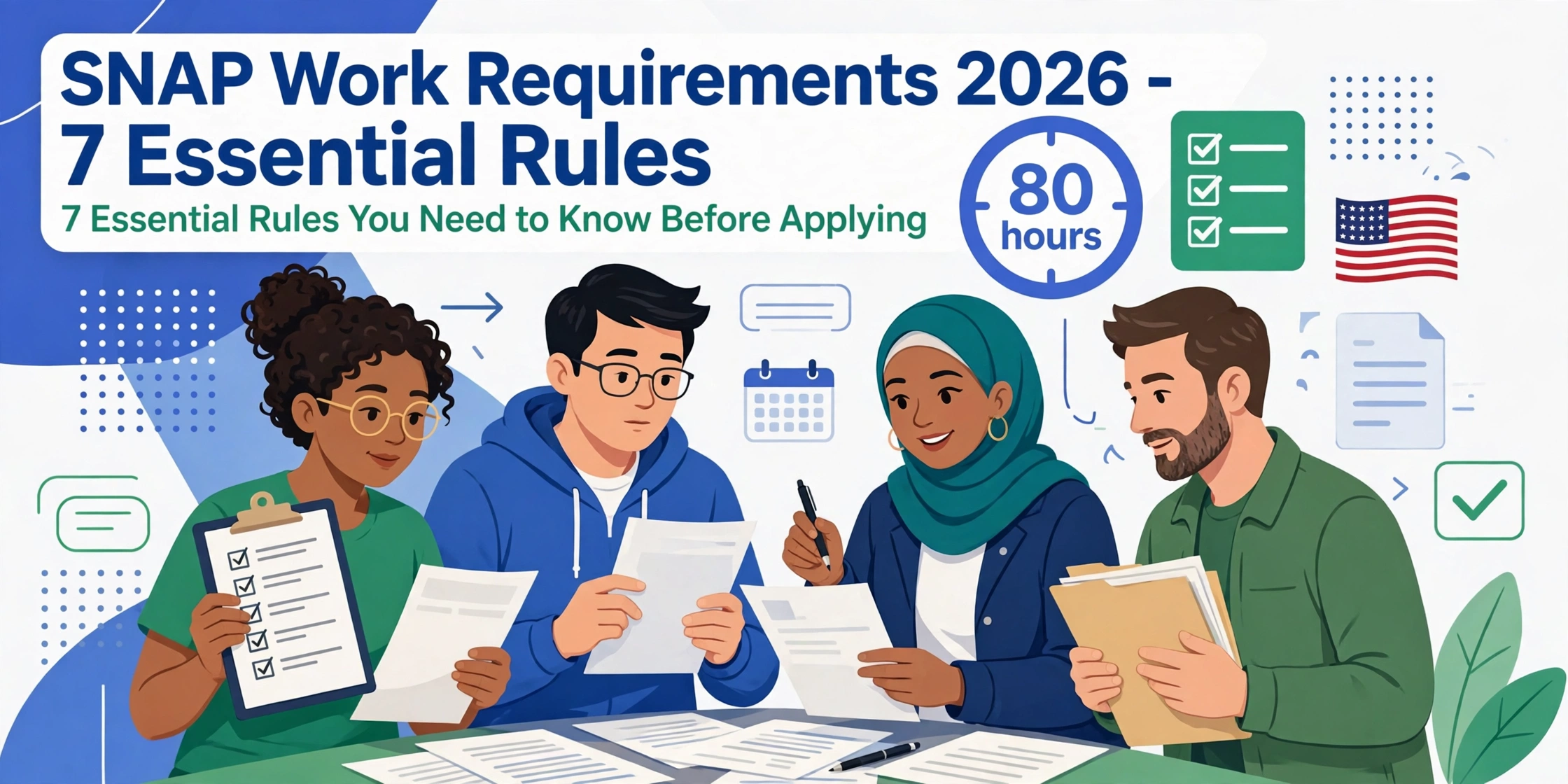
SNAP Work Requirements 2026: 7 Essential Rules You Need to Know Before Applying
Introduction: What Are SNAP Work Requirements in 2026?
The SNAP work requirements are important rules that some people must follow to receive or continue receiving food assistance in the United States. SNAP stands for the Supplemental Nutrition Assistance Program. It helps eligible individuals and families pay for groceries when their household income and circumstances meet program guidelines.
Many people depend on SNAP benefits to manage their monthly food budgets. However, applying for benefits involves more than completing a form. Depending on your age, employment situation, household responsibilities, and other circumstances, you may need to register for work, participate in an approved employment program, or meet additional work-related conditions.
Understanding these rules is especially important in 2026 because federal legislation enacted in 2025 changed certain SNAP work requirements and exemptions. Information published before those changes may not accurately explain the rules that apply today.
The good news is that you can take practical steps to understand your responsibilities. You can review the requirements, check whether an exemption applies, prepare your employment records, and contact your state SNAP agency when you need clarification.
In this guide, we explain seven essential rules, who may need to follow them, how the monthly work requirement operates, and what to do if you receive a notice about your benefits.
1. Understanding the Basic SNAP Work Requirements
The first step is understanding that SNAP has general work requirements as well as additional rules that may apply to certain adults. These rules do not apply in exactly the same way to everyone.
General work requirements are intended to encourage eligible recipients to maintain employment or participate in appropriate employment-related activities when required.
Registering for work
Certain SNAP applicants and recipients must register for work and follow the employment instructions provided by their state agency. This may include providing information about their employment status or following instructions for finding suitable work.
Registering for work does not necessarily mean that every person must immediately obtain a full-time job. The exact responsibilities depend on the applicable rules and whether the person qualifies for an exemption.
If you receive instructions from your SNAP agency, read them carefully. Ask your caseworker to explain anything you do not understand.
Accepting suitable employment
Some people subject to general work requirements may face consequences if they refuse suitable employment without a recognized good reason.
For example, suppose an eligible recipient receives a reasonable job offer that meets the applicable standards. Refusing that offer without an acceptable reason could affect their benefits under the relevant rules.
However, the agency must consider the circumstances and the rules applicable to the case. Not every job offer automatically qualifies as suitable employment.
Leaving a job or reducing work hours
Voluntarily quitting a job or reducing working hours without a valid reason can also affect SNAP eligibility in certain situations.
For example, a person who leaves a job without a recognized good cause may need to explain the circumstances to the agency. Reasons related to health, working conditions, or other relevant circumstances may require individual consideration.
If you must leave a job, keep relevant documents and explain the situation honestly when asked.
Participating in employment and training programs
Some recipients may be required or encouraged to participate in employment and training activities. These programs can help participants improve job skills, prepare for interviews, or find suitable employment.
Keep records of attendance, completed activities, and any instructions from the program.
Important: General SNAP work requirements are different from the additional time-limit rules discussed later in this article. Understanding which rules apply to your case is essential.
2. Who Must Meet SNAP Work Requirements in 2026?
Not every person who receives SNAP must meet the same employment conditions. Your age, ability to work, household circumstances, and eligibility for an exemption can affect your responsibilities.
General work requirements for adults
Federal SNAP rules generally require certain adults aged 16 through 59 to register for work, subject to exceptions and exemptions. Additional requirements may apply to people who refuse suitable employment or do not follow assigned employment instructions.
A person’s ability to work and specific circumstances may affect how these rules apply. Therefore, it is important to check your individual requirements instead of assuming that every adult faces identical obligations.
Additional requirements for certain adults without dependents
Some adults are subject to additional work requirements associated with a time limit on SNAP benefits. These rules are commonly discussed using the term able-bodied adults without dependents, or ABAWDs.
The 2025 federal legislation changed the groups covered by these rules and revised certain exemptions. As a result, older articles may describe age limits or exemption categories that no longer accurately reflect the current federal framework.
If you are an adult without dependents and are applying for SNAP, ask your state agency whether the additional requirements apply to you.
Why household circumstances matter
Your household situation can affect which work rules apply. For example, caring for a qualifying dependent, having a qualifying disability, or meeting another recognized exemption may change your obligations under a particular rule.
However, an exemption from one requirement does not automatically mean that every other SNAP rule is waived.
An example
Consider two people applying for SNAP.
The first person works regular hours at a local store. The second person is unemployed and does not have dependents. Their employment obligations may differ because of their individual circumstances, exemptions, and the rules applicable to their cases.
The second person should not automatically assume they are ineligible. Instead, they should ask the state agency which requirements apply and whether any exemption or qualifying activity is available.
Remember: Employment status alone does not determine SNAP eligibility. Income, household circumstances, and other program rules also matter.
3. The 80-Hour Monthly Work Requirement Explained
One of the most frequently discussed SNAP work requirements is the 80-hour monthly activity requirement. This rule is particularly relevant to people subject to the additional time-limit rules.
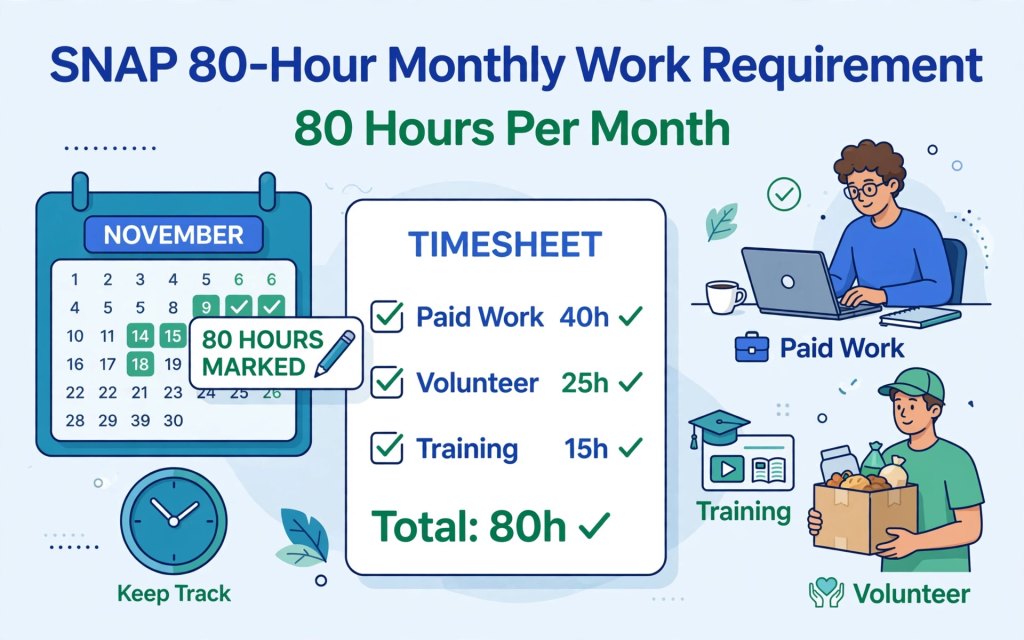
Generally, individuals covered by those additional rules must meet the applicable qualifying work or activity requirement, commonly at least 80 hours per month, unless an exemption or other applicable provision changes their obligations.
This requirement does not automatically apply to every SNAP applicant or recipient.
What counts toward the 80 hours?
Depending on the applicable rules, qualifying activities may include:
- Paid employment.
- Certain qualifying unpaid work or volunteer activities.
- Approved employment and training programs.
- Qualifying workfare activities.
- A combination of eligible work and approved activities.
Not every volunteer activity, training course, or unpaid arrangement automatically qualifies. Check with your state SNAP agency before relying on an activity to meet the requirement.
How to calculate your monthly hours
For someone who is subject to the 80-hour requirement, the calculation involves counting the hours that qualify under the applicable rules.
For example, imagine that a person completes 52 hours of qualifying employment during a month and another 28 hours in an approved employment program. If both activities qualify, the combined total is 80 hours.
This example shows how eligible activities can sometimes be combined. It does not mean that every applicant can count any job-training or volunteer hours toward the requirement.
Keep proof of your work activities
Maintaining accurate records can help you respond to questions from your SNAP agency.
Useful records may include:
- Recent pay stubs.
- Employer letters confirming work hours.
- Work schedules and timesheets.
- Employment and training attendance records.
- Documents showing participation in an approved program.
- Written notices from your SNAP agency.
Keep copies of these documents in a safe place. If your hours change, update your records and follow your state’s reporting instructions.
What if your work hours change?
Work schedules can change because of reduced shifts, seasonal employment, illness, or other circumstances.
If your hours fall below the applicable requirement, contact your caseworker promptly. Ask whether your situation affects your eligibility, whether another qualifying activity is available, and whether any exemption applies.
Do not assume that a temporary change automatically ends your benefits. Your situation must be evaluated under the rules that apply to your case.
4. SNAP Work Requirement Exemptions: Who May Qualify?
Understanding exemptions is one of the most important parts of learning about SNAP work requirements. Some people are exempt from particular work rules because of their circumstances.
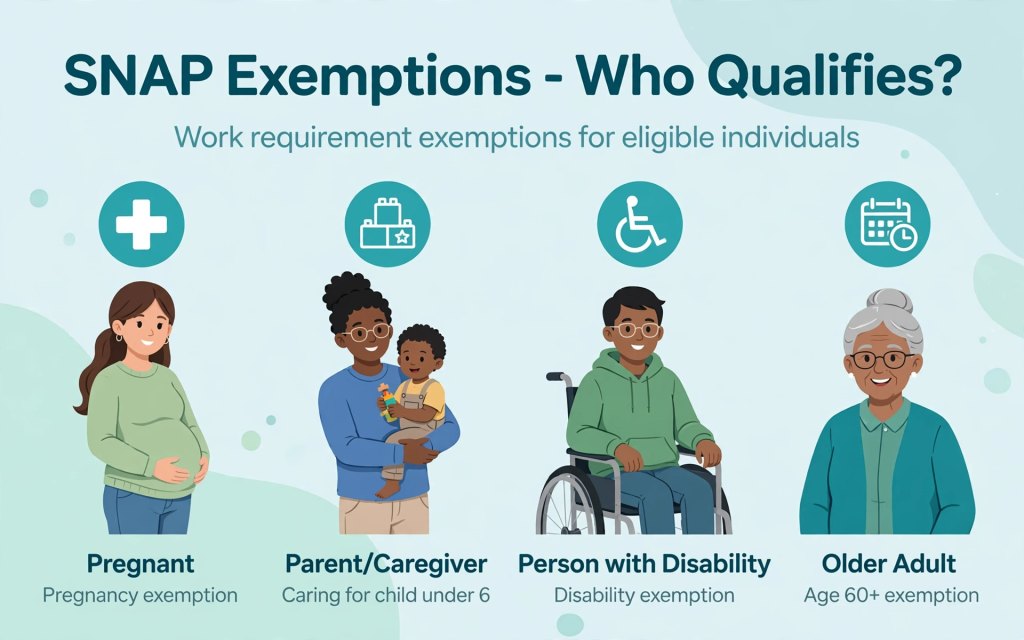
However, exemptions are not identical across all requirements. An exemption from general work registration, for example, may not have exactly the same effect as an exemption from the additional time limit.
People with qualifying disabilities or limitations
A physical or mental condition that prevents someone from working may affect whether particular work requirements apply.
The relevant rules determine whether the person qualifies for an exemption. The state agency may ask for information or documentation to establish eligibility.
If a health-related limitation affects your ability to work, explain your circumstances to the agency and ask what documentation is required.
Parents and caregivers
Some parents and caregivers qualify for exemptions under particular SNAP work rules.
For example, general work requirements contain provisions related to caring for a qualifying child or an incapacitated household member. The exact conditions depend on the applicable rule.
Do not assume that caring for any family member automatically removes every work obligation. Ask the agency which exemption applies to your household.
Age can affect SNAP work obligations, but the rules differ between general work requirements and the additional time-limit provisions.
Federal legislation enacted in 2025 changed certain age-related provisions associated with the additional time limit. For this reason, applicants should confirm the current rules rather than relying on older online guidance.
Pregnancy and other circumstances
Pregnancy and other personal circumstances may be relevant when determining whether someone qualifies for a particular exemption or exception. The result depends on the specific federal or state rule involved.
It is important not to assume that one circumstance automatically removes every employment-related obligation.
How to check whether you qualify
If you believe an exemption applies, contact your state SNAP agency and ask:
- Which SNAP work requirements applies to my case?
- Does my situation qualify for an exemption?
- What documents do I need to provide?
- When must I submit those documents?
- Will I need to report changes in my circumstances?
Keep copies of any forms and responses you receive.
Important 2026 reminder: Federal rules changed in 2025, and government guidance has been updated as those changes are implemented. Verify current exemptions with your state agency before making decisions about work or benefits.
5. Understanding the Three-Month SNAP Benefit Time Limit
The additional SNAP work requirements rules can include a time limit for certain adults who do not meet the applicable requirements.
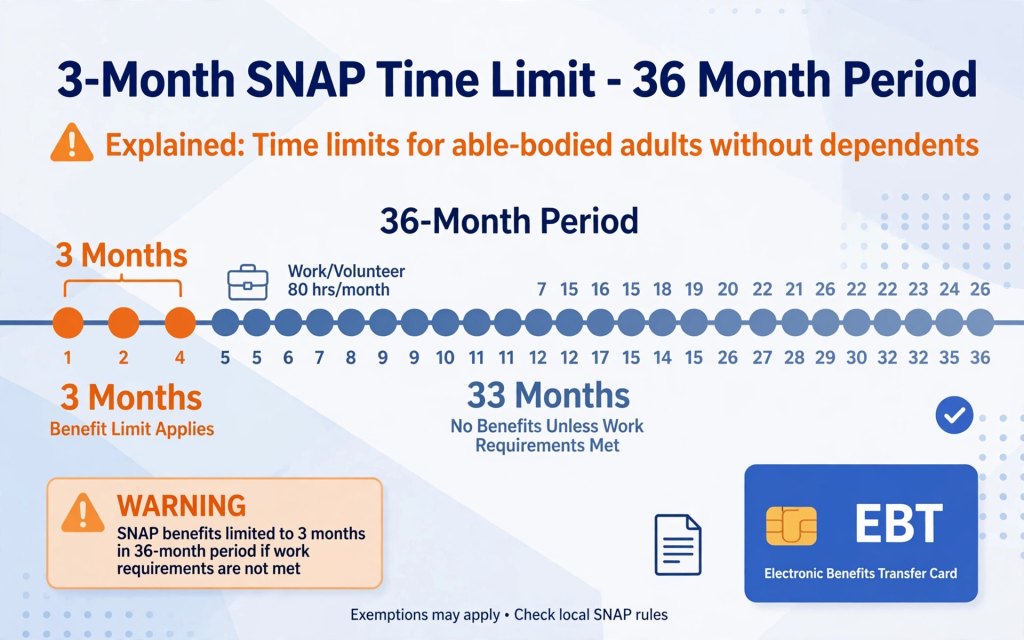
Under the general framework, people subject to this time limit who do not meet the required qualifying work or activity conditions and do not qualify for an exemption or applicable waiver may receive benefits for only three months within a 36-month period.
This rule does not apply to every SNAP recipient.
How the time limit works
If the additional time-limit rules apply to you, the agency may review whether you meet the required activity conditions or qualify for an exemption.
If you do not meet the applicable conditions, your benefits may be limited under the relevant rules. The precise result depends on your case, your eligibility history, and the rules implemented by your state.
How qualifying activities can help
People subject to the additional rules may be able to meet the requirement through qualifying work or approved activities.
For example, an eligible person might combine paid employment with participation in an approved employment program. Whether those hours count depends on the applicable requirements.
If you are unsure whether your activities qualify, ask your caseworker before relying on them.
What about state waivers?
Certain areas may qualify for waivers under federal rules. State implementation and the availability of waivers can affect how the time limit applies.
Do not assume that a waiver exists in your area simply because you read about it online. Confirm the current situation with your state agency.
What should you do if you receive a warning?
If you receive a notice stating that you may be approaching a benefit time limit, read it carefully.
Check the following details:
- The date of the notice.
- The work requirement the agency says applies.
- Any hours or activities recorded in your case.
- Whether the agency has considered your reported circumstances.
- The deadline for responding or providing documents.
If information is missing or incorrect, contact the agency and ask how to submit supporting records.
Keep your own records
A personal record of work hours, training participation, notices, and communications can help you understand your case. It can also make it easier to identify a mistake if the agency’s records do not match your own.
The most important point is to act promptly. Do not wait until your benefits stop before asking questions about a time-limit notice.
6. How to Apply for SNAP and Report Your Work Activities
Applying for SNAP can feel complicated, especially if you are unsure which work rules apply. Following a few practical steps can make the process easier.
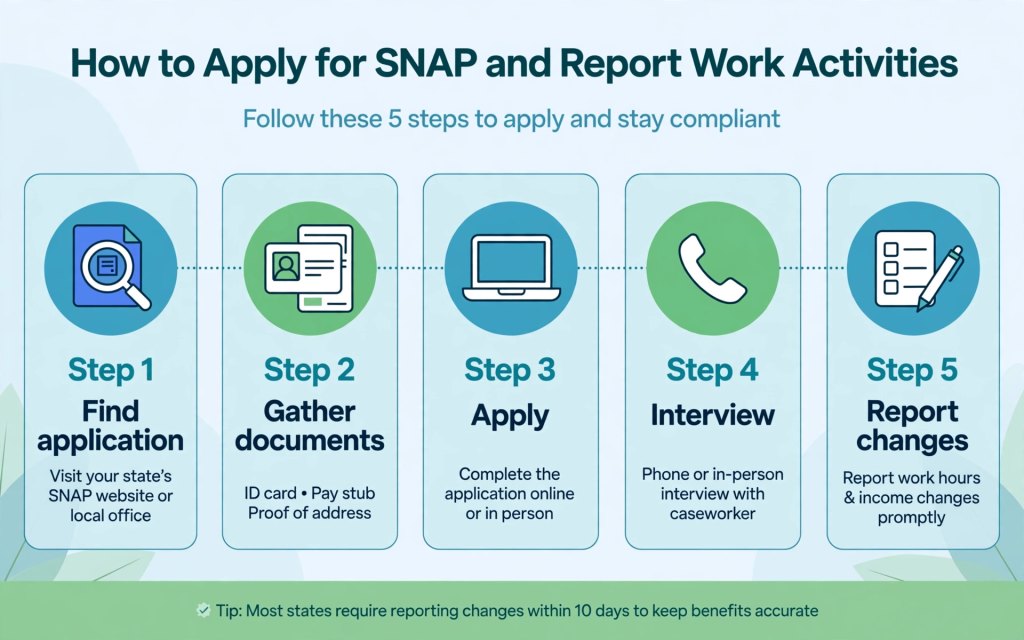
Step 1: Find your state’s SNAP application process
SNAP work requirements is administered by state agencies under federal requirements. Applicants generally apply through the state where they live.
Depending on the state, you may be able to apply online, in person, by mail, or through another available method.
Use the official state agency’s information to find the correct application process.
Step 2: Gather the information you may need
Before starting your application, prepare the information the agency may request.
This can include:
- Identification and household details.
- Income and employment information.
- Recent pay stubs or other income records.
- Housing and utility expenses.
- Information about household members.
- Documents related to circumstances that may affect your work obligations.
Not every applicant will need every document. Requirements depend on the person’s circumstances and state procedures.
Step 3: Complete the application accurately
Answer the questions honestly and review your information before submitting it.
If you are unemployed, work part-time, participate in training, or have recently changed jobs, provide accurate details when requested.
Do not guess about your work hours or report activities that you have not completed. If you are uncertain how to answer a question, ask the agency for clarification.
Step 4: Attend your interview if required
The agency may need to conduct an interview or request additional information to process your application.
Respond to requests within the stated deadlines. Keep copies of documents you submit and record important dates.
If you cannot attend a scheduled interview, contact the agency to ask about available alternatives or rescheduling.
After receiving benefits, follow your state’s instructions for reporting changes.
Relevant changes may include starting a job, losing employment, changes in working hours, or a change in circumstances that may affect an exemption.
The reporting rules and deadlines depend on your case. Review your notices so you know what you are required to report and when.
Step 6: Ask questions about your work obligations
If you are unsure whether a particular rule applies, ask your caseworker to explain it.
You can ask whether you must register for SNAP work requirements, participate in an employment program, meet the additional monthly activity requirement, or provide proof of an exemption.
Getting clarification early may help you avoid mistakes and unnecessary stress.
Remember that work rules are only one part of eligibility
Meeting SNAP work requirements does not automatically guarantee approval. The agency also considers other applicable eligibility conditions, including household income and circumstances.
Likewise, being unemployed does not automatically mean that you cannot qualify for SNAP.
Your application should be evaluated according to the requirements that apply to your household.
7. What Happens If You Do Not Meet SNAP Work Requirements?
Failing to meet an applicable work requirement can affect SNAP work requirements benefits, but the consequences depend on which rule applies and the circumstances of the case.
If you receive a warning or notice, do not ignore it. Read it carefully and find out what action the agency expects you to take.
Possible benefit consequences
Failure to follow certain general work requirements may result in disqualification under the applicable rules.
SNAP work requirements For people subject to the additional time limit, failure to meet the required qualifying activities may also affect how long they can receive benefits.
These outcomes are not necessarily identical. The agency must consider the specific requirement and any relevant exemption or exception.
Explain circumstances that affected your work
Sometimes a person cannot complete a required activity because of circumstances outside their control.
For example, illness, a household emergency, or another serious situation may affect the person’s ability to work or attend a program. Whether the situation qualifies as good cause depends on the applicable rules and the facts of the case.
Tell the agency what happened and provide supporting information when requested.
Correct mistakes in your records
Suppose you completed qualifying training hours but the agency’s records do not show them. Gather your attendance records and ask how to correct the information.
Similarly, if you believe an exemption was overlooked, explain the circumstances and ask what documents are needed.
Do not assume that an error will correct itself automatically.
Ask about appeal rights
If you disagree with a decision affecting your SNAP benefits, you may have the right to request a fair hearing.
Read the notice to understand the reason for the decision, the relevant deadline, and the procedure for challenging it.
If you need help, ask the state agency about available assistance or consult a qualified benefits adviser.
Keep communication records
Whenever possible, keep copies of letters, forms, and documents submitted to the agency. Record the dates of important calls and the information you receive.
These records can be useful if you need to explain your situation or challenge a decision.
The key is to respond promptly, ask clear questions, and make sure the agency has accurate information about your circumstances.
Frequently Asked Questions About SNAP Work Requirements 2026
1. Do all SNAP recipients have to work?
No. Some recipients must follow general work requirements, while others may also be subject to additional work rules. Exemptions and individual circumstances can change which requirements apply.
2. How many hours must I work to receive SNAP benefits?
For people subject to the additional time-limit rules, the qualifying work or activity requirement is generally at least 80 hours per month. This does not mean every SNAP recipient must work 80 hours each month.
3. Can I receive SNAP if I work part-time?
Yes. Part-time workers may qualify for SNAP if they meet the applicable eligibility rules. Their income, household circumstances, work activities, and any relevant exemptions may affect the outcome.
4. Who is exempt from SNAP work requirements in 2026?
Exemptions depend on the particular requirement and the person’s circumstances. Certain disabilities, caregiving responsibilities, and other qualifying conditions may be relevant. Because federal legislation changed some exemptions in 2025, confirm your status with your state SNAP agency.
5. Can I lose SNAP benefits if I do not meet the work requirements?
Yes, failing to meet an applicable requirement may result in disqualification or a benefit time limit. The consequences depend on the specific rule and whether an exemption, exception, or other provision applies.
6. Do SNAP work requirements differ by state?
Federal law establishes the main framework, but states administer the program and may differ in procedures, program availability, and implementation. Always check the current rules for your state.
7. Where can I check my SNAP work requirement status?
Contact your state SNAP agency, review official notices, or sign in to your state benefits account if online access is available. Ask which work rules apply to your case and whether you need to provide additional documents.
Conclusion: Understand SNAP Work Requirements Before Applying
Understanding the SNAP work requirements in 2026 can help you prepare for the application process and manage your food assistance benefits with greater confidence.
The most important things to remember are that general work requirements differ from the additional time-limit rules, the 80-hour monthly requirement does not apply to everyone, and certain people may qualify for exemptions.
Keep accurate employment records, report relevant changes according to your state’s instructions, and respond promptly to official notices. If you believe an exemption applies or you disagree with a decision, contact your state SNAP agency and ask about the appropriate next steps.
Federal legislation enacted in 2025 changed important parts of the SNAP work rules. Therefore, make sure you use current information instead of relying on outdated articles or assumptions.
Before applying, take time to understand your household’s circumstances, review the applicable requirements, and ask questions whenever something is unclear. A little preparation can help you avoid preventable mistakes and make more informed decisions about your food assistance benefits.
Disclaimer: This article provides general educational information and is not a determination of eligibility. SNAP rules and their implementation can change. Contact your state SNAP agency for guidance specific to your circumstances.