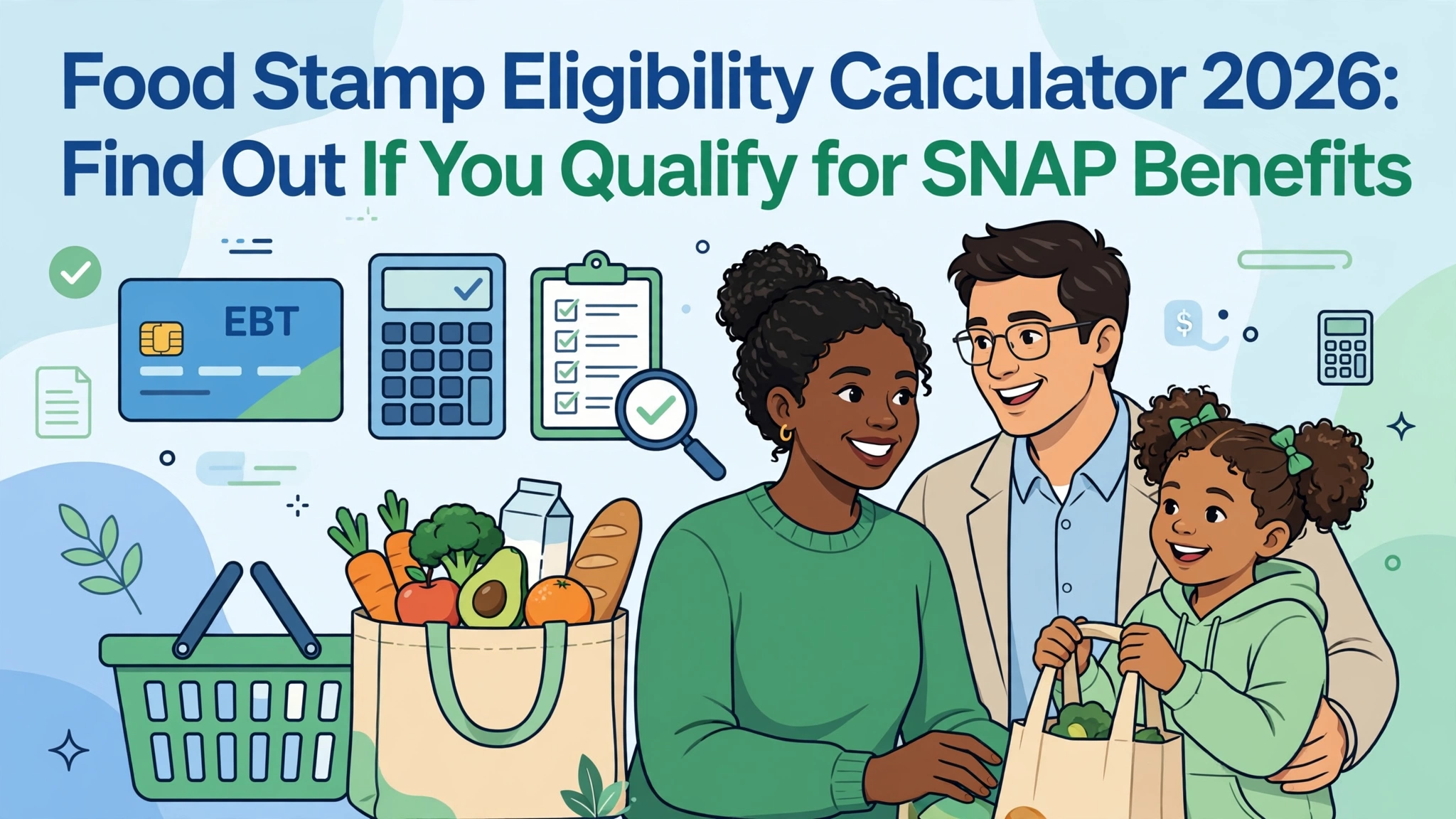
Food Stamp Eligibility Calculator 2026: Find Out If You Qualify for SNAP Benefits
If you are finding it difficult to pay for groceries, you may be wondering whether you qualify for food stamps. The good news is that you can check your potential eligibility before completing a full application. A food stamp eligibility calculator can help you understand how your household size, income, and living expenses may affect your chances of receiving benefits.
The Supplemental Nutrition Assistance Program, commonly known as SNAP, helps eligible households buy food. Benefits are generally provided through an Electronic Benefits Transfer (EBT) card that works at participating grocery stores and other approved retailers.
However, qualifying for SNAP is not always as simple as earning less than a particular amount. Your household circumstances, allowable deductions, state rules, and other eligibility requirements can all affect the result.
In this guide, you will learn how to use a food stamp eligibility calculator in 2026, understand income limits, estimate your potential monthly benefits, and apply through your state’s official SNAP agency.
1. What Is a Food Stamp Eligibility Calculator?
A food stamp eligibility calculator is an online screening tool that helps you estimate whether you might qualify for SNAP benefits. Depending on the tool, it may also provide an estimate of how much assistance your household could receive each month.
The calculator generally uses information about your household, income, and certain expenses. Some tools also ask about your state of residence and whether a household member is older or has a disability.
For example, imagine that you live with your spouse and two children. You have a job, but after paying rent, utilities, and other bills, you have limited money left for food. A calculator can help you understand how your earnings and eligible expenses might affect your potential SNAP eligibility.
A calculator is useful because it gives you a starting point. Instead of guessing whether your income is too high, you can enter your information and review an estimate.
What information does a calculator use?
Depending on the tool, you may need to provide:
- Your state of residence.
- The number of people in your SNAP household.
- Monthly income from employment.
- Other countable income.
- Housing and utility expenses.
- Childcare or dependent-care expenses.
- Certain medical expenses, if applicable.
Not every calculator requests the same information. Some offer a quick screening based on income and household size, while others provide a more detailed estimate.
Remember that a food stamp eligibility calculator does not guarantee approval. Your state SNAP agency must review your application and determine whether you meet the applicable requirements.
2. Who Qualifies for SNAP Benefits in 2026?
SNAP is designed to help eligible households with limited resources afford food. However, the program has financial and nonfinancial requirements that applicants must meet.
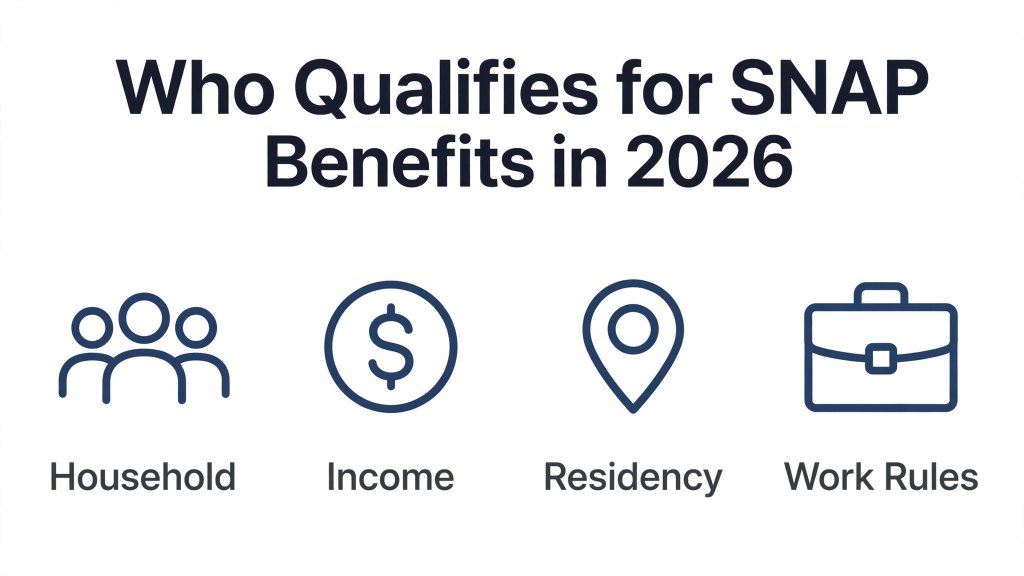
The first step is understanding how SNAP defines a household. It does not always count everyone living at the same address as one household. Generally, people who live together and purchase and prepare food together are considered one SNAP household, subject to specific rules.
Certain family relationships have special rules. For example, spouses living together and children under age 22 living with a parent generally must be included together under SNAP household rules.
Income and financial circumstances
Your income is an important part of the eligibility decision. Many households must meet gross-income and net-income tests, although exceptions and alternative eligibility pathways can apply.
Gross income is generally counted before deductions, while net income for SNAP is calculated after applicable deductions.
Residency and other requirements
You generally need to apply in the state where you currently live. Citizenship and eligible immigration-status rules also apply, and eligibility can depend on the status of individual household members.
Some applicants may face additional requirements, including certain work-related rules. Special provisions may apply to older adults and people with disabilities.
Because requirements can change, review the current rules before applying. The USDA SNAP eligibility page is a useful starting point for understanding federal program requirements.
Using a food stamp eligibility calculator can help you organize your information, but only the appropriate agency can make an official eligibility determination.
3. Food Stamp Income Limits for 2026
One of the most common questions applicants ask is, “How much can I earn and still qualify for food stamps?”
The answer depends on several factors, including household size, location, and the eligibility rules that apply to your household.
For the 48 contiguous states and the District of Columbia, the USDA’s federal baseline income standards for October 1, 2026, through September 30, 2027 are shown below. These are the standards applicable during the current part of calendar year 2026.
| Household size | Gross monthly income limit | Net monthly income limit |
|---|---|---|
| 1 person | $1,729 | $1,330 |
| 2 people | $2,345 | $1,804 |
| 3 people | $2,960 | $2,277 |
| 4 people | $3,575 | $2,750 |
| 5 people | $4,191 | $3,224 |
| 6 people | $4,806 | $3,697 |
| 7 people | $5,421 | $4,170 |
| 8 people | $6,037 | $4,644 |
<small>Source: USDA SNAP income eligibility standards, effective October 1, 2026, through September 30, 2027. These are baseline standards for the 48 contiguous states and the District of Columbia, not universal limits for every household. Alaska and Hawaii have different standards, and applicable state options or special household rules may change how eligibility is evaluated.</small>
What is gross income?
Gross income generally means your household’s countable income before deductions. It can include wages and other income sources, depending on the program’s rules.
For example, if you earn $2,000 per month before taxes, your gross monthly income is generally $2,000 before any applicable SNAP exclusions or deductions are considered.
What is net income?
Net income for SNAP is not simply the amount deposited into your bank account after taxes. It is calculated by subtracting allowable SNAP deductions from gross income.
Depending on your circumstances, deductions may include a portion of earned income, a standard deduction, qualifying dependent-care expenses, certain medical expenses, and eligible shelter costs.
Why should you use a calculator?
The income table is a useful starting point, but it does not tell the whole story. Some states use broad-based categorical eligibility or other applicable options that affect financial screening.
For this reason, do not automatically assume you are ineligible because your income exceeds a baseline figure. Use a food stamp eligibility calculator that reflects your state and circumstances, then confirm the result with your state agency.
4. How to Use a Food Stamp Eligibility Calculator Step by Step
Using a food stamp eligibility calculator is usually straightforward. The most important thing is to enter accurate information and follow the instructions provided by the tool.
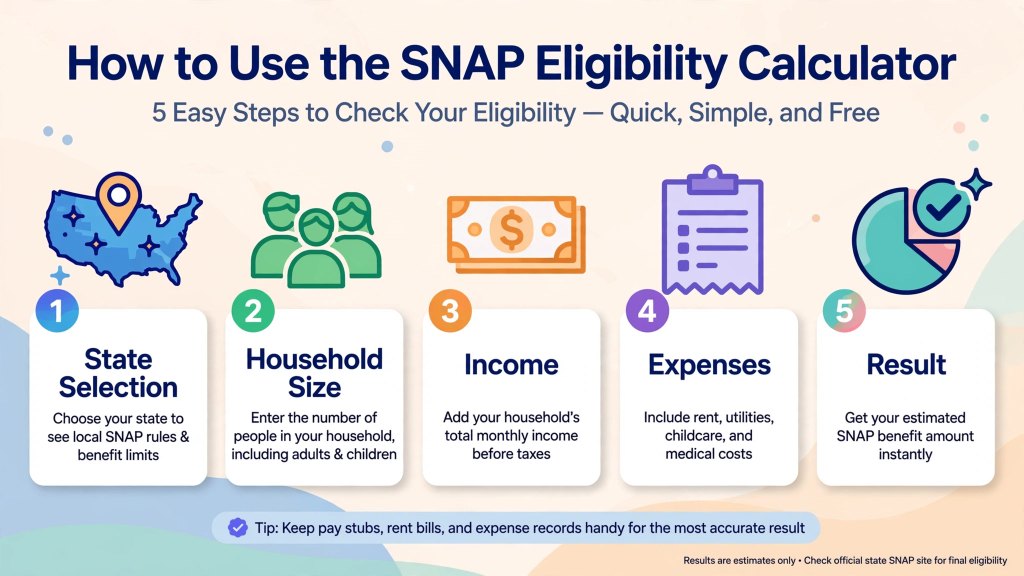
Step 1: Select your state
Start by choosing the state where you currently live. SNAP is administered by state agencies, and rules, application procedures, and certain financial eligibility options can vary.
Using the wrong state can produce an inaccurate estimate.
Step 2: Enter your household size
Enter the number of people who count as part of your SNAP household. Do not automatically include every person who shares your home.
For instance, roommates who buy and prepare their food separately may be treated differently from family members who are required to be included together under SNAP rules.
Step 3: Enter your monthly income
Provide your income according to the calculator’s instructions. This may include wages, self-employment earnings, and other relevant income.
If your earnings change from week to week, gather recent pay information and use the reporting method requested by the tool.
Step 4: Add relevant expenses
Enter any expenses the calculator requests, such as rent, eligible utility costs, childcare, or qualifying medical expenses.
These details matter because allowable deductions may reduce the income used to determine eligibility and benefits.
Step 5: Review your estimated result
The calculator may indicate whether you appear likely to qualify and may estimate a potential monthly benefit.
Read the result carefully. An estimate is not an official decision, and the final amount can differ after the agency verifies your circumstances.
Step 6: Check the official application process
If the result suggests you may qualify, visit your state’s official SNAP website to learn how to apply. You can generally begin an application without waiting for a calculator to confirm eligibility.
5. What Information Do You Need Before Using the Calculator?
Preparing your information in advance can make the process faster and more accurate.
Start with your household details. Make a list of the people who may count as members of your SNAP household and identify any circumstances that could affect the household rules.
Next, gather your income information. Recent pay stubs, self-employment records, and information about other income sources can help you enter realistic figures.
You should also collect details about relevant expenses, including:
- Monthly rent or mortgage costs.
- Utility expenses requested by the calculator.
- Childcare or dependent-care costs.
- Qualifying child support payments, where applicable.
- Eligible medical expenses for older adults or people with disabilities.
- Other financial details requested by the screening tool.
You do not need to submit all these documents just to use a calculator. However, you may need supporting documents when you complete an official application.
If you are uncertain whether an expense counts, check the tool’s instructions or your state agency’s guidance rather than guessing.
A food stamp eligibility calculator is most useful when the information you enter reflects your real circumstances.
6. How Much Could You Receive in SNAP Benefits?
Qualifying for SNAP does not mean every household receives the same amount. Monthly benefits depend on household size, countable income, allowable deductions, location, and the maximum benefit available under the applicable rules.
The USDA generally calculates a household’s benefit by subtracting approximately 30% of its net monthly income from the maximum monthly allotment for its household size, subject to program rules and rounding.
Maximum monthly SNAP benefits
For the 48 contiguous states and the District of Columbia, the maximum monthly allotments for October 1, 2026, through September 30, 2027, are:
| Household size | Maximum monthly benefit |
|---|---|
| 1 person | $306 |
| 2 people | $562 |
| 3 people | $808 |
| 4 people | $1,023 |
| 5 people | $1,217 |
| 6 people | $1,463 |
| 7 people | $1,616 |
| 8 people | $1,841 |
Source: USDA SNAP allotment and cost-of-living information.
These figures are maximum allotments, not guaranteed payments. Actual benefits may be lower, and different amounts apply in Alaska, Hawaii, Guam, and the U.S. Virgin Islands.
A simple example
Suppose a four-person household qualifies for SNAP and has a calculated net monthly income of $1,000.
The maximum monthly allotment for a four-person household in the contiguous states and the District of Columbia is $1,023 under the current standards.
For a simplified illustration:
- Maximum allotment: $1,023.
- Approximately 30% of net monthly income: $300.
- Illustrative monthly benefit: $723.
This example explains the basic calculation but is not an official benefit estimate. The agency must determine the household’s actual net income, apply the relevant rules, and calculate the final allotment.
A food stamp eligibility calculator can help you explore possible outcomes before applying.
7. What Expenses Can Affect SNAP Eligibility?
Your expenses can make a difference because SNAP rules allow certain deductions when calculating net income.
However, not every bill qualifies as a deduction. The agency must follow specific rules when reviewing your household’s finances.
Housing and utility expenses
Rent, certain mortgage costs, and eligible utility expenses may affect the shelter deduction. The amount recognized depends on applicable rules, household circumstances, and state procedures.
For some households, qualifying shelter expenses can reduce the income used to calculate benefits.
Childcare and dependent care
If you pay for dependent care because you work, participate in training, or attend education required for employment, you may qualify for a deduction under applicable rules.
Keep records of these costs so you can provide accurate information when needed.
Medical expenses
Eligible households with older adults or people with disabilities may be able to deduct qualifying out-of-pocket medical expenses above the applicable threshold.
Not every medical bill qualifies, and expenses paid by insurance or another person generally cannot be counted as the household’s own unreimbursed expense.
Child support payments
Certain legally owed child support payments may qualify for a deduction, depending on the applicable rules and state implementation.
When using a food stamp eligibility calculator, enter expenses only in the categories the tool requests. If you are unsure whether a cost qualifies, verify the rule with your state agency.
8. How SNAP Eligibility Rules Differ by State
Although SNAP operates under federal law, state agencies administer the program and may use different options allowed by federal rules.
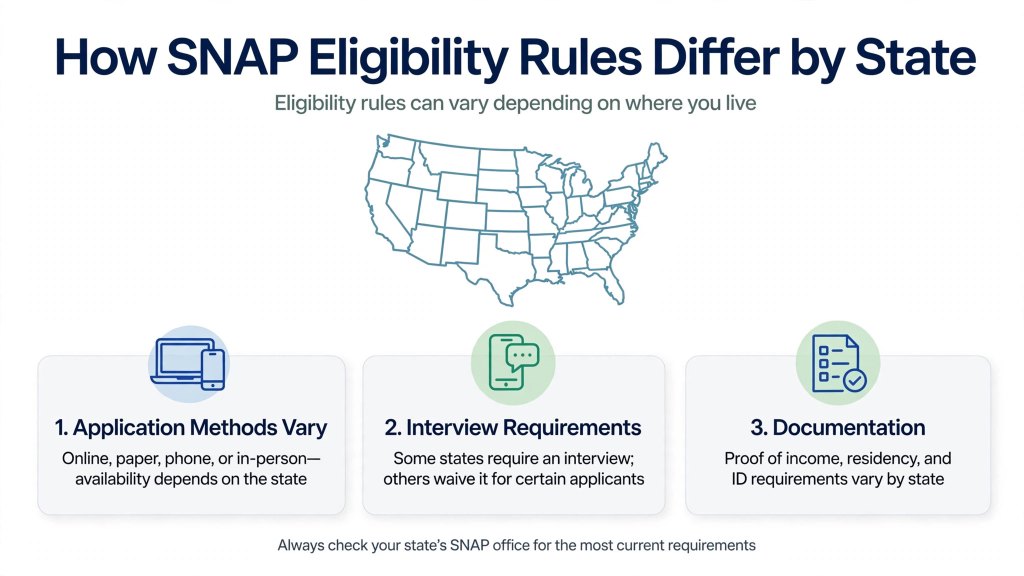
For example, some states use broad-based categorical eligibility. This can change how certain income and resource rules apply to eligible households.
States can also differ in their application websites, interview procedures, document-submission methods, and administrative practices.
This is why a food stamp eligibility calculator should be appropriate for your state. A calculator designed around another state’s rules may give you a misleading result.
To find reliable information:
- Visit the USDA’s official SNAP website.
- Identify your state’s SNAP agency.
- Review the current eligibility and application instructions.
- Use the state’s screening tool if one is available.
- Contact the agency if your household has unusual circumstances.
If you live in a state that provides an online benefits portal, you may also be able to submit an application and track notices through that system.
9. How to Apply for Food Stamps After Checking Eligibility
Once you have used a food stamp eligibility calculator, you can move on to the official application process if you believe you may qualify.
Find the official state application website
Start with the USDA’s SNAP state directory. Select your state to locate the appropriate agency and application information.
Be careful with websites that charge unnecessary fees or promise guaranteed approval. A screening tool should help you understand your options, not pressure you to pay for a government benefit application.
Complete the application accurately
Provide the information requested about household members, income, living arrangements, and expenses.
Answer each question honestly. If you are uncertain how to answer something, consult the application instructions or ask the agency for help.
Provide supporting documents
The agency may ask you to verify information such as income, identity, residency, or expenses. Submit the requested documents using the approved method and within the stated deadlines.
Complete an interview if required
SNAP applications generally involve an eligibility interview. The agency may use the interview to clarify your circumstances or request additional information.
Monitor your application
Check your mail, online account, or other official communication channels for updates. Respond promptly to agency requests and keep copies of submitted documents when possible.
Under federal processing standards, eligible households generally must have an opportunity to participate within 30 days of applying. Households that qualify for expedited service may receive benefits within seven days. Expedited processing is subject to specific criteria, and not every applicant qualifies.
Even if a food stamp eligibility calculator gives you an uncertain result, you can contact your state agency to ask whether submitting an application makes sense for your circumstances.
10. Common Mistakes to Avoid When Checking SNAP Eligibility
A calculator can only provide a useful estimate when you enter the right information. Avoid these common mistakes.
Using the wrong income figure
Some tools ask for gross income, while others may request additional details for deductions. Read each question carefully instead of automatically entering your take-home pay.
Counting household members incorrectly
SNAP household rules can be more specific than simply counting everyone who lives under one roof. Consider purchasing and preparing food together, as well as rules that apply to spouses and certain children.
Forgetting allowable expenses
Leaving out relevant housing, dependent-care, or qualifying medical expenses may make your estimate less accurate.
Using outdated figures
Income standards and maximum benefits change periodically. Make sure you are using figures that apply to the relevant benefit year and location.
Assuming the calculator guarantees approval
A screening tool does not review every detail of your case. The state agency makes the official determination after reviewing your application and required information.
Ignoring official notices
Missing an interview, failing to provide requested documents, or overlooking a deadline can delay the process or affect your application.
Use official government websites or reputable screening tools. Be cautious about providing Social Security numbers, bank details, or other sensitive information to websites that have not established their legitimacy.
By avoiding these mistakes, you can make a food stamp eligibility calculator a more useful first step in understanding SNAP benefits.
11. Frequently Asked Questions About the Food Stamp Eligibility Calculator
Can I check SNAP eligibility online for free?
Yes. Many state agencies and reputable nonprofit organizations offer free screening tools. You can also review the USDA’s official SNAP information to understand the program’s requirements.
What is the income limit for food stamps in 2026?
For October 1, 2026, through September 30, 2027, the baseline gross monthly income limit in the 48 contiguous states and the District of Columbia is $1,729 for one person and $3,575 for four people. Net-income limits are $1,330 and $2,750, respectively. These figures do not apply universally to every household or state, so verify the rules that apply to you.
Can I qualify for SNAP if I work full-time?
Possibly. Having a job does not automatically make you ineligible. Your income, allowable deductions, household circumstances, and applicable eligibility rules determine whether you qualify. Some applicants may also be subject to work-related requirements.
Can a household with no income receive food stamps?
A household with little or no income may qualify if it meets the other requirements. The agency may ask how the household covers basic expenses and may need to verify its circumstances.
Does a food stamp eligibility calculator guarantee approval?
No. A calculator provides an estimate based on the information entered and the assumptions used by the tool. The state agency makes the official eligibility decision.
How long does it take to receive SNAP benefits after applying?
Eligible households generally must have an opportunity to participate within 30 days. Certain households that meet expedited-service criteria may receive benefits within seven days. Processing can depend on the application, verification, and individual circumstances.
Can college students qualify for SNAP?
Some college students qualify, but special eligibility rules may apply to people enrolled in higher education at least half-time. Certain exemptions can help eligible students meet the requirements. Check the current rules with your state agency.
Can I use a food stamp eligibility calculator if my income changes every month?
Yes, if the calculator supports your circumstances. Gather accurate information about your earnings and follow the tool’s instructions for variable income. The state agency will determine how your income should be evaluated for the official application.
What should I do if the calculator says I do not qualify?
Review the information you entered and make sure you used the correct state and current standards. If you are still unsure, contact your state SNAP agency. A screening result is not a formal denial, and special circumstances may affect eligibility.
12. Final Thoughts: Check Your SNAP Eligibility With Confidence
Paying for groceries can be stressful when household income must also cover rent, utilities, transportation, childcare, and other everyday expenses. Learning about available food assistance can help you make more informed decisions.
A food stamp eligibility calculator is a practical starting point. It allows you to review your household size, income, and relevant expenses to estimate whether you may qualify for SNAP benefits in 2026.
However, remember that estimates are not guarantees. Eligibility standards, deductions, and benefit amounts depend on your state and household circumstances. Use current information, provide accurate details, and confirm important questions with an official agency.
If you believe you may qualify, visit your state’s SNAP website, review the application requirements, and submit an application when you are ready.
Take the first step today: check your potential eligibility, gather the information you need, and explore the official resources available to help your household access food assistance.