Child Support 2026: 7 Essential Things Every Parent Needs to Know
Introduction: Understanding Child Support in 2026
Raising a child comes with many responsibilities, and financial support is one of the most important. When parents live separately, they may need to understand how to share the costs of raising their children. This is where child support becomes important.
Child support is financial assistance intended to help cover a child’s everyday needs, including food, housing, clothing, education, childcare, and healthcare. Depending on the applicable laws and support order, one parent may be required to make regular payments to help the other parent meet these expenses.
In 2026, many parents are looking for clear information about child support rules, payment amounts, application procedures, and their legal responsibilities. Some want to apply for support for the first time, while others need help understanding an existing order or dealing with missed payments.
However, child support laws are not the same everywhere. The rules can vary between countries and, in the United States, between states. Therefore, it is important to understand the general principles and check the requirements that apply to your location.
In this guide, we will explain seven essential things every parent needs to know about child support in 2026. You will learn how payments work, how amounts are calculated, how to apply, what happens when payments are missed, and when a support order may be changed.
1. What Is Child Support and Why Is It Important?
Child support is financial assistance intended to help provide for a child’s needs when parents live separately or have different living arrangements. It is generally established through a court order, an administrative process, or another legally recognized arrangement, depending on the jurisdiction.
The main purpose of child support is to help ensure that children receive financial support from their parents. Even when parents no longer live together, their responsibilities toward their children may continue.
What expenses can child support cover?
Raising a child involves more than buying food or paying for school supplies. Families have many expenses throughout the year, and child support may contribute toward several of them.
Common expenses include:
- Food and groceries: Children need regular meals and nutritious food to support their growth.
- Housing: Financial contributions may help cover rent, mortgage payments, utilities, and other household costs.
- Clothing: Children need suitable clothing, shoes, and other personal items as they grow.
- Education: School supplies, books, transportation, and certain educational expenses may be relevant.
- Healthcare: Medical insurance, appointments, prescriptions, and eligible healthcare expenses may be considered.
- Childcare: Daycare and other childcare costs may be included in a support calculation.
- Transportation: Getting children to school, medical appointments, and activities can create additional costs.
The exact expenses covered depend on local law and the terms of the support order. Some expenses may be addressed separately rather than included in the regular monthly payment.
Why is child support important for children?
Child support can help provide financial stability, especially when one parent handles most of the child’s everyday care. Regular financial contributions may make it easier to plan for groceries, housing, school needs, and other essential expenses.
It is also important to understand that child support is not a payment for access to a child. Financial support and parenting time are separate issues under many legal systems. A disagreement about visitation does not automatically cancel a support obligation, and missed payments do not automatically remove parenting rights.
The key point: Child support is intended to contribute to a child’s well-being. Parents should understand their responsibilities and follow the legal requirements that apply to their family.
2. Who Is Required to Pay Child Support?
One of the most common questions parents ask is who must pay child support. The answer depends on the applicable law, the family’s circumstances, and whether a court or authorized agency has established a support obligation.
In many cases, the parent who does not provide most of the child’s daily care may be required to make payments to the other parent. However, this is not a universal rule. Courts and agencies may consider the income of both parents, their parenting arrangements, and other relevant factors.
Does the parent with higher income always pay?
Not necessarily. A parent’s income is often an important part of the calculation, but it is not the only factor.
For example, a jurisdiction may use a formula that considers both parents’ incomes, the number of children, healthcare expenses, childcare costs, and parenting time. The result depends on the specific formula and the information available.
A parent with a higher income may have a greater financial responsibility in some circumstances. In other cases, the calculation may produce a different result.
No. Shared custody does not automatically mean that child support is unnecessary.
Even if children spend substantial time with both parents, their financial circumstances may differ. One parent may earn significantly more than the other, or certain expenses may be assigned differently.
For example, imagine that a child spends several nights each week with each parent. One parent earns considerably more, while the other pays a larger share of certain everyday expenses. Depending on local rules, a support payment may still be appropriate.
This is only an illustration. The actual outcome depends on the jurisdiction’s calculation method and the family’s circumstances.
What if parents have an informal agreement?
Parents may agree privately on how to share expenses. However, an informal agreement may not have the same legal status as an enforceable support order.
If an order already exists, parents should not assume that a private agreement automatically changes the required payment. They should check the applicable rules and obtain formal approval or modification when necessary.
Remember: Child support responsibilities are determined by applicable law, not simply by a parent’s personal preference. If you are unsure about your obligations, contact the relevant child support agency or seek qualified legal advice.
3. How Is Child Support Calculated in 2026?
Understanding how child support is calculated can help parents prepare for an application, review an existing order, or estimate their possible financial responsibilities.
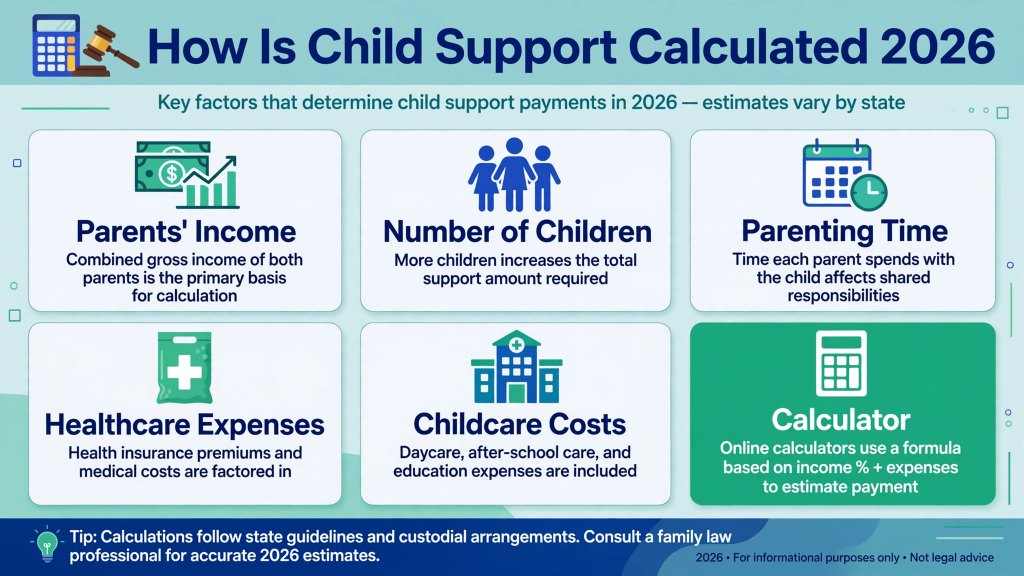
There is no single payment formula that applies to every family. Some jurisdictions use an income-shares model, while others use different approaches. The amount can also depend on whether the case involves special expenses or circumstances.
Factors that may affect child support calculations
1. Parents’ income
Income is often one of the most important factors. Depending on local law, calculations may include wages, self-employment earnings, bonuses, commissions, or other sources of income.
Some jurisdictions use gross income, while others use adjusted or net income according to their rules.
2. Number of children
The number of children covered by a support order can affect the payment amount. Supporting three children may involve different calculations from supporting one child.
3. Parenting time
The amount of time each parent cares for a child may affect the calculation. Some systems consider overnight stays or other measures of parenting time.
However, more parenting time does not necessarily eliminate a support obligation.
4. Healthcare expenses
Health insurance premiums and certain medical costs may be included in the calculation or assigned separately to one or both parents.
5. Childcare costs
Expenses related to daycare or childcare that allows a parent to work may affect the final amount.
6. Other legally recognized responsibilities
Depending on local rules, certain existing support obligations, deductions, or additional financial circumstances may be considered.
Can you use a child support calculator?
A child support calculator can provide a useful estimate when an official tool is available for your jurisdiction.
These calculators may ask for information such as:
- Each parent’s income.
- The number of children.
- Parenting time.
- Health insurance costs.
- Childcare expenses.
- Other information required by the local formula.
After entering the requested information, the calculator may produce an estimated payment amount.
However, an online estimate is not necessarily the final amount. The result can be inaccurate if information is missing, entered incorrectly, or interpreted under the wrong jurisdiction’s rules.
For that reason, use an official government calculator whenever possible and confirm the final obligation with the appropriate authority.
Does child support automatically increase every year?
Not necessarily. Some jurisdictions provide for periodic adjustments or reviews under specific circumstances, while others require a formal modification process. Inflation alone does not automatically change every support order.
If your income or expenses have changed significantly, check whether you can request a review.
4. How to Apply for Child Support in 2026
Applying for child support may feel complicated, particularly for parents who have never dealt with a court or government agency. Understanding the general process can make the experience easier to manage.
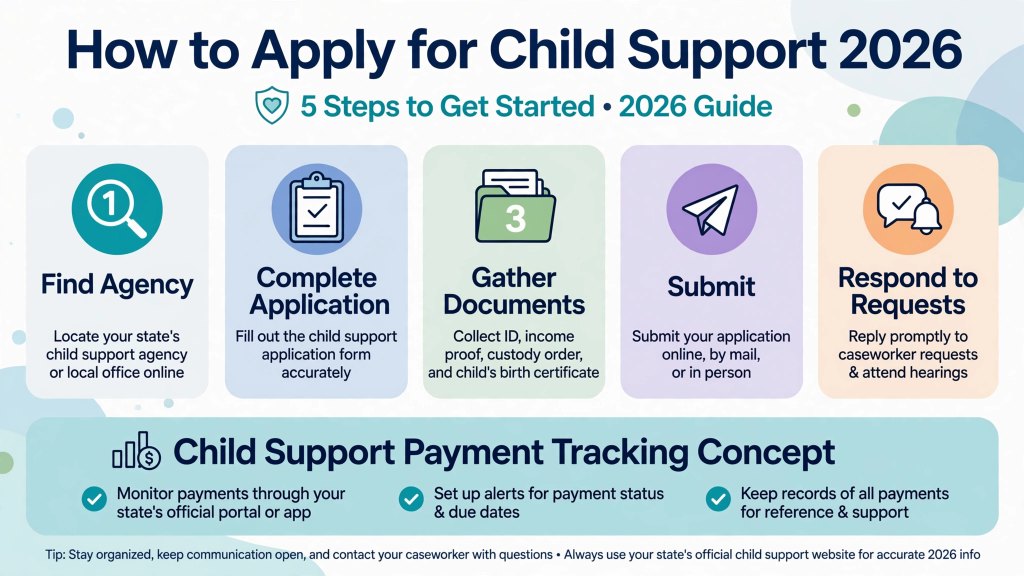
In the United States, parents can often begin by contacting their state or local child support agency. In other countries, the appropriate authority may be a family court or another government department.
Step 1: Find the correct child support agency
Start by identifying the official agency responsible for child support in your location.
If you live in the United States, the federal Office of Child Support Services provides information about the child support program and links to state resources. You can visit the official website at https://www.acf.hhs.gov/css.
Make sure you use a genuine government website. Avoid submitting sensitive information through unfamiliar websites that claim to offer official application services.
Step 2: Complete the application
The application will usually ask for information about the applicant, the child, and the other parent.
You may need to provide contact details, information about the child’s living arrangements, and details of any existing court order.
Answer questions as accurately as possible. If you do not know certain information about the other parent, ask the agency how to complete that part of the application.
Step 3: Gather supporting documents
The documents required depend on your location and circumstances. Common examples include:
- Identification documents.
- The child’s birth certificate.
- Income or employment information.
- Existing custody or support orders.
- Available information about the other parent.
- Records of payments already made, where relevant.
You may not need every document on this list. Check the official instructions before submitting your application.
Step 4: Submit your application
Depending on the agency, you may be able to apply online, by mail, or in person.
Keep a copy of your completed application and any confirmation number you receive. If you submit documents electronically, save the confirmation or receipt.
Step 5: Respond to requests from the agency
The agency may need additional information before it can establish or enforce a support obligation.
For example, the process may involve establishing parentage, locating the other parent, reviewing financial information, or arranging a hearing.
Respond to requests promptly and keep copies of the documents you provide.
How long does a child support application take?
There is no universal processing time. The timeline depends on the jurisdiction, the complexity of the case, whether parentage needs to be established, and whether the other parent can be located.
If you have not received an update, contact the agency using its official contact information.
Helpful tip: Applying for child support is easier when you keep your documents organized and understand which agency handles your case.
5. What Happens If a Parent Does Not Pay Child Support?
Missed payments can create financial difficulties for the parent caring for a child and may lead to legal consequences for the parent who owes the money.
When unpaid support accumulates, it is commonly called child support arrears. The rules governing arrears, collection, and enforcement depend on the jurisdiction and the existing support order.
Possible consequences of unpaid child support
Wage withholding
In many cases, child support payments can be deducted from a parent’s wages and sent through the relevant payment system. This process may help ensure that payments are made regularly.
Tax refund interception
Under applicable rules, certain tax refunds may be intercepted to collect qualifying unpaid child support.
Collection from certain assets
Some jurisdictions allow authorities to collect qualifying arrears from specified financial accounts or other assets, subject to legal requirements.
Court proceedings
A parent who fails to comply with a support order may be required to attend a court hearing. The court can consider the circumstances and determine what action is legally appropriate.
Other enforcement measures
Depending on local law, additional measures may be available. These can have serious consequences, so parents should seek accurate information about their rights and obligations.
Not every enforcement measure applies to every case, and some actions require specific procedures or findings.
What if you cannot afford your payments?
Losing a job, experiencing a reduction in income, or facing unexpected expenses can make payments difficult.
If this happens, do not assume that the support obligation automatically decreases. Contact the relevant child support agency and ask whether you can request a modification.
Continue following the existing order unless it is formally changed or the applicable authority confirms a different arrangement.
What if a payment was made but not recorded?
Sometimes, payment records may not reflect a recent payment immediately. If you believe a payment has not been credited, gather your receipts, bank records, or payment confirmations.
Contact the agency and ask how to resolve the discrepancy. Keep copies of all correspondence.
Important: Unpaid child support does not necessarily disappear automatically. Parents should address payment problems early and use the official process to resolve disputes.
6. Can Child Support Payments Be Changed?
Yes, child support payments may be changed in certain circumstances. However, the process depends on local law, the terms of the existing order, and the evidence supporting the request.
A parent generally cannot change a legally established payment simply by deciding to pay less or by reaching an informal agreement with the other parent.
Common reasons for requesting a modification
A significant income change
If a parent’s income increases or decreases substantially, they may be able to request a review. The authority will determine whether the change justifies a different amount under the applicable rules.
Job loss
Losing employment can make it difficult to meet existing financial obligations. A parent may be able to request a modification, but unemployment does not automatically cancel the order.
Changes in parenting arrangements
If the amount of time a child spends with each parent changes substantially, this may affect the calculation in some jurisdictions.
Higher childcare or healthcare expenses
Significant changes in eligible childcare costs, insurance premiums, or medical expenses may provide grounds for review.
Other major circumstances
Certain other changes may qualify, depending on the jurisdiction’s laws and procedures.
How to request a child support modification
The usual process may involve contacting the relevant child support agency or court, completing a request, and submitting updated financial information.
You may need documents showing current income, employment changes, childcare expenses, healthcare costs, or changes in parenting arrangements.
The authority will review the information and decide whether the order should change.
Can you reduce payments while waiting?
Do not assume that you can pay less while your request is being considered. Unless the order is changed or the law provides otherwise, the existing obligation may remain in effect.
Rules about retroactive changes also vary. In some jurisdictions, a modification may only take effect from a particular date or after specific legal steps have been taken.
Best practice: If your circumstances change, act promptly. Understanding the modification process can help you avoid accumulating arrears and make sure your support order reflects the circumstances recognized by local law.
7. How to Check Child Support Payments and Case Status
Once a child support case is established, parents may need to check whether payments have been received, review their payment history, or find out whether the agency has updated the case.
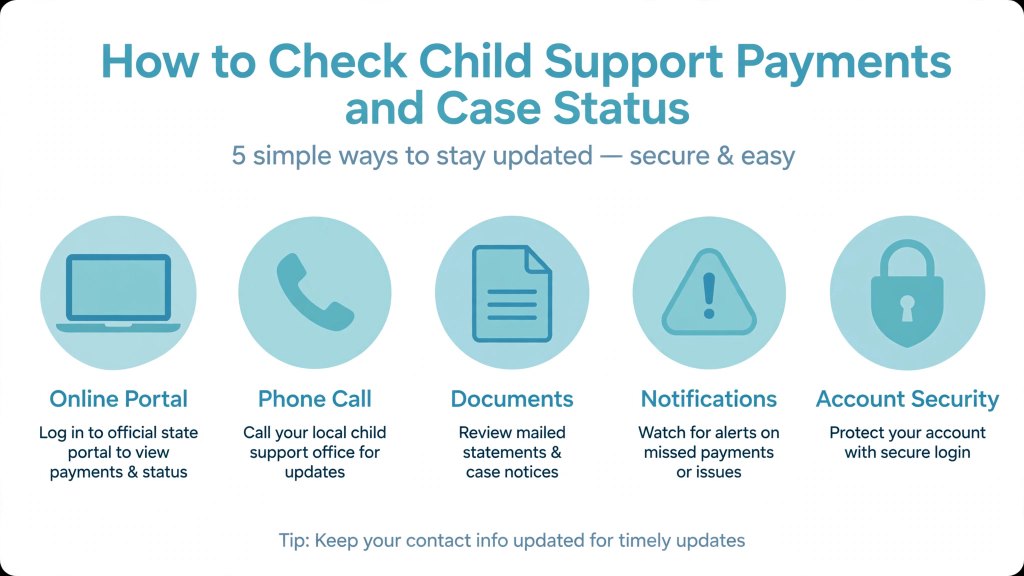
The available methods depend on your location and the agency responsible for your case.
Check your case online
Many child support agencies provide online portals where eligible users can view case information.
Depending on the portal, you may be able to review payment history, see certain case updates, or access account information.
Use the official website for your state or jurisdiction. You may need a case number and identity verification to sign in.
Contact the child support agency by phone
If you cannot access your online account, contact the agency using its official telephone number.
Before calling, gather your case number and any relevant payment information. This may help the agency locate your record and respond more efficiently.
Do not share passwords or verification codes with someone who contacts you unexpectedly.
Review payment records
Keep records of payments made and received. Depending on your circumstances, these records may include:
- Payment receipts.
- Bank statements.
- Electronic payment confirmations.
- Official payment histories.
- Letters or notices from the agency.
Organized records can help you identify missing payments and resolve disagreements.
What should you do if a payment is missing?
First, check the payment date and processing time. A recent payment may not appear immediately.
If the payment remains missing, contact the agency and provide the relevant details. Ask whether additional documentation is needed.
If you believe the amount recorded is incorrect, keep copies of your evidence and follow the agency’s dispute or correction process.
Protect your personal information
Child support cases may involve sensitive information about parents and children. Avoid entering personal details into unofficial websites or responding to suspicious messages asking for payment or account information.
Use secure, official channels whenever possible.
Remember: Checking your child support case regularly and keeping accurate records can help you understand your financial responsibilities and identify problems early.
Frequently Asked Questions About Child Support in 2026
It may be. Shared custody does not automatically eliminate child support. Income, parenting time, eligible expenses, and local calculation rules can all affect the outcome.
2. Does child support cover college expenses?
The answer depends on the jurisdiction and the support order. Some places may allow certain educational expenses to be addressed, while others generally follow different rules after a child reaches adulthood.
Parents should check the law that applies to their case.
3. Can parents agree on child support without going to court?
Parents may be able to reach an agreement privately. However, an agreement may need formal approval or a legally enforceable order. If an existing order is in place, parents should follow the required modification process.
4. When does child support end?
Child support does not end at exactly the same age in every jurisdiction. The child’s age, educational status, disability-related provisions, and the terms of the order may affect the end date.
Parents should confirm the applicable rules instead of assuming that payments stop automatically on a birthday.
5. Can child support be paid directly to the other parent?
That depends on the support order and local procedures. In some cases, direct payments may not be credited automatically toward the official obligation.
Before changing payment methods, confirm the rules with the agency or court responsible for the case. Keep proof of every payment.
6. What happens if a parent moves to another state?
Moving to another state does not necessarily end a child support obligation. Interstate cases may involve cooperation between agencies and specific rules governing which state can establish or modify an order.
Contact the appropriate child support agency before making assumptions about how a move affects your case.
7. Can child support be changed if someone loses a job?
A parent may be able to request a modification after a significant income change, but the result depends on local law and the circumstances. The existing order generally remains important until it is properly changed.
8. Where can I find official child support information?
In the United States, the federal Office of Child Support Services provides general information and links to state child support programs at https://www.acf.hhs.gov/css.
For case-specific requirements, use the official website of the relevant state or local agency.
Conclusion: What Every Parent Should Remember About Child Support in 2026
Understanding child support in 2026 can help parents make better decisions about their children’s financial needs and their own legal responsibilities.
The seven essential areas covered in this guide include understanding what child support means, knowing who may be required to pay, learning how payments are calculated, applying through the appropriate agency, addressing unpaid support, requesting modifications, and checking payment records.
Each situation is different. The amount a parent may owe, the documents required for an application, and the consequences of missed payments depend on local law and the details of the case.
If you are applying for child support, keep your documents organized and follow the official application process. If you are already paying or receiving support, maintain accurate records and review your case information when necessary. If your financial circumstances change, ask the relevant authority about the proper procedure rather than making informal changes to an existing order.
Most importantly, remember that child support is intended to help meet a child’s needs. Understanding the rules, communicating appropriately, and following the required legal procedures can help parents manage their responsibilities more confidently.
By staying informed about child support, you can better understand your options, protect your interests, and focus on providing a stable environment for your child.